
Labour Day
Labor Day, International Workers' Day, and May Day, is a day off for workers in many countries around the world.

Lunar New Year celebrations, also known as the Spring Festival, in China start on the 23rd day of the 12th lunar month of the Chinese calendar. The festival lasts for about 23 days, ending on the 15th day of the first lunar month in the following year in the Chinese calendar.
Chinese New Year is a public holiday. It is a day off for the general population, and schools and most businesses are closed.
In 2024, it falls on a Saturday, and some businesses may choose to follow Saturday opening hours.
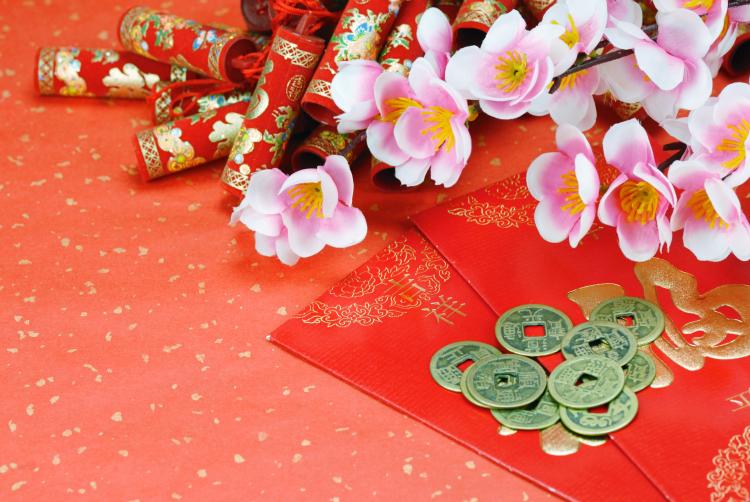
Lunar New Year decorations, including red envelopes for money.
©iStockphoto.com/Liang Zhang
The Lunar New Year date changes every year, falling no earlier than January 21 and no later than February 21. But why? Read our holiday news article on this very topic.
Many people clean their homes to welcome the Spring Festival. They put up the red posters with poetic verses on it to their doors, Lunar New Year pictures on their walls, and decorate their homes with red lanterns. It is also a time to reunite with relatives so many people visit their families at this time of the year.
In the evening of the Spring Festival Eve, many people set off fireworks and firecrackers, hoping to cast away any bad luck and bring forth good luck. Children often receive “luck” money. Many people wear new clothes and send Lunar New Year greetings to each other. Various activities such as beating drums and striking gongs, as well as dragon and lion dances, are all part of the Spring Festival festivities.
The Spring Festival is a national holiday in China. Government offices, schools, universities and many companies are closed during the period from the Spring Festival Eve to the seventh day of the first lunar month in the Chinese calendar. However, some enterprises such as banks often arrange for workers to be on shift duty. Public transport is available during the Lunar New Year period.
According to historical documents, on the day when Shun, who was one of ancient China’s mythological emperors, came to the throne more than 4000 years ago, he led his ministers to worship heaven and earth. From then on, that day was regarded as the first day of the first lunar month in the Chinese calendar. This is the basic origin of Lunar New Year.
China adopted the Gregorian calendar in 1911, so Lunar New Year was renamed the Spring Festival.
Each new year year is represented by a Zodiac animal sign. The red posters with poetic verses on it were initially a type of amulet, but now it simply means good fortune and joy. Various Lunar New Year symbols express different meanings. For example, an image of a fish symbolizes “having more than one needs every year”. A firecracker symbolizes “good luck in the coming year”. The festival lanterns symbolize “pursuing the bright and the beautiful”.
| Year | Weekday | Date | Name | Holiday Type |
|---|---|---|---|---|
| 2019 | Tue | Feb 5 | Chinese New Year | National holiday |
| 2020 | Sat | Jan 25 | Chinese New Year | National holiday |
| 2021 | Fri | Feb 12 | Chinese New Year | National holiday |
| 2022 | Tue | Feb 1 | Chinese New Year | National holiday |
| 2023 | Sun | Jan 22 | Chinese New Year | National holiday |
| 2024 | Sat | Feb 10 | Chinese New Year | National holiday |
| 2025 | Wed | Jan 29 | Chinese New Year | National holiday |
| 2026 | Tue | Feb 17 | Chinese New Year | National holiday |
| 2027 | Sat | Feb 6 | Chinese New Year | National holiday |
| 2028 | Wed | Jan 26 | Chinese New Year | National holiday |
| 2029 | Tue | Feb 13 | Chinese New Year | National holiday |
While we diligently research and update our holiday dates, some of the information in the table above may be preliminary. If you find an error, please let us know.
Labor Day, International Workers' Day, and May Day, is a day off for workers in many countries around the world.
How does the 12-hour clock system work? Is midnight 12 am or 12 pm?
Why do many countries set the clocks back and forth an hour twice a year?

Why are there 12 months? How long are they, and what do the month names mean?