
Ascension Day
Ascension Day is the 40th day of Easter and commemorates Jesus Christ’s ascension into heaven, according to Christian belief.

Many Australians celebrate Lunar New Year, also known as the Spring Festival or Chinese New Year. It marks the first day of the New Year in the Chinese calendar.
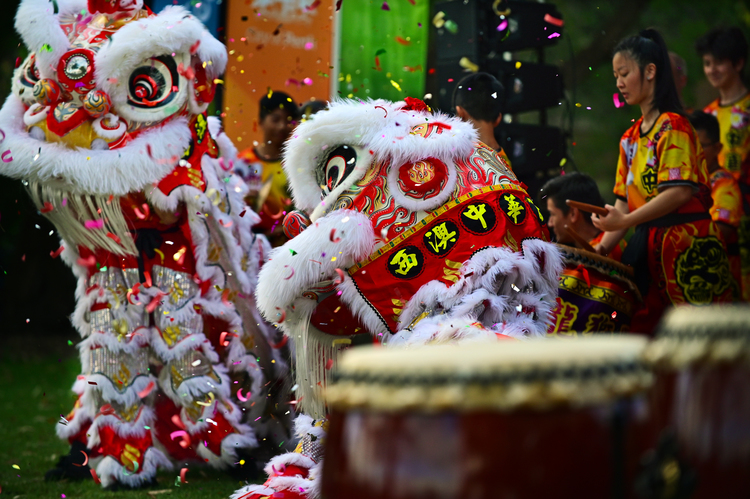
Chinese Lion Dancing for Lunar New Year in Perth, Australia.
©iStockphoto.com/chameleonseye
The Lunar New Year date changes every year, falling no earlier than January 21 and no later than February 21. But why? Read our holiday news article on this very topic.
Like in many countries around the world, Lunar New Year celebrations in Australia include the following events and activities:
Many Chinese Australian families spend Lunar New Year by gathering together for a festive meal. Children often receive red envelopes with money (Hong Bao, Ang Pao, or Lai See). The Lunar New Year celebrations can last for about 15 days. It is usually a busy time filled with festive programs across different communities in Australia.
Lunar New Year is not a nationwide public holiday in Australia. However, some Chinese businesses may be closed on the day or amend their business hours to take part in the Lunar New Year festivities. There may be heavy traffic and some streets may be closed in towns or cities where Lunar New Year celebrations are held.
Chinese people first came to Australia in large numbers during Australia’s Gold Rush in the 1850s and 1860s. About one-third of the miners were Chinese. Many Chinese-Australian families can trace their settlement in Australia to that time. Monuments and buildings developed by Chinese settlers serve as reminders of the long history of Chinese immigration to Australia. Examples remain in towns such as Ballarat and Bendigo in Victoria. The Chinese-Australian community holds a variety of events to celebrate festivals such as Lunar New Year.
Lunar New Year has various symbols and traditions. For example, flowers are an important part of New Year decorations. Writings that refer to good luck are often seen in homes and business environments. They are usually written by brush on a diamond-shaped piece of red paper. Tangerines and oranges are also displayed in many homes and stores as a sign of luck and wealth.
Envelopes with money (Hong Bao, Ang Pao, or Lai See) often come in the color red, which symbolizes happiness, good luck, success and good fortune. These envelopes are mainly given as presents to children. Each Lunar New Year is associated with an animal name for one of 12 animals in the Chinese zodiac.
| Year | Weekday | Date | Name | Holiday Type | Area |
|---|---|---|---|---|---|
| 2019 | Tue | Feb 5 | Lunar New Year | Observance | |
| 2019 | Tue | Feb 5 | Lunar New Year | State Holiday | Christmas Island |
| 2020 | Sat | Jan 25 | Lunar New Year | Observance | |
| 2020 | Tue | Jan 28 | Lunar New Year Observed | State Holiday | Christmas Island |
| 2021 | Fri | Feb 12 | Lunar New Year | Observance | |
| 2021 | Fri | Feb 12 | Lunar New Year | State Holiday | Christmas Island |
| 2022 | Tue | Feb 1 | Lunar New Year | Observance | |
| 2022 | Tue | Feb 1 | Lunar New Year | State Holiday | Christmas Island |
| 2023 | Sun | Jan 22 | Lunar New Year | Observance | |
| 2023 | Sun | Jan 22 | Lunar New Year | State Holiday | Christmas Island |
| 2024 | Sat | Feb 10 | Lunar New Year | Observance | |
| 2024 | Sat | Feb 10 | Lunar New Year | State Holiday | Christmas Island |
| 2024 | Mon | Feb 12 | Day off for Lunar New Year | State Holiday | Christmas Island |
| 2025 | Wed | Jan 29 | Lunar New Year | Observance | |
| 2025 | Wed | Jan 29 | Lunar New Year | State Holiday | Christmas Island |
| 2026 | Tue | Feb 17 | Lunar New Year | Observance | |
| 2026 | Tue | Feb 17 | Lunar New Year | State Holiday | Christmas Island |
| 2027 | Sat | Feb 6 | Lunar New Year | Observance | |
| 2027 | Sat | Feb 6 | Lunar New Year | State Holiday | Christmas Island |
| 2028 | Wed | Jan 26 | Lunar New Year | Observance | |
| 2028 | Wed | Jan 26 | Lunar New Year | State Holiday | Christmas Island |
| 2029 | Tue | Feb 13 | Lunar New Year | Observance | |
| 2029 | Tue | Feb 13 | Lunar New Year | State Holiday | Christmas Island |
While we diligently research and update our holiday dates, some of the information in the table above may be preliminary. If you find an error, please let us know.
Ascension Day is the 40th day of Easter and commemorates Jesus Christ’s ascension into heaven, according to Christian belief.

Mother’s Day is celebrated in Australia on the second Sunday of May each year.

Many Jewish communities in Australia celebrate Yom Ha’Atzmaut, which is Israel’s Independence Day, on the fifth day of the month of Iyar in the Jewish calendar.
Many Christians in Australia observe Pentecost, also known as Whitsunday or Whit Sunday.