
Skywatching Tips for December 2025
What’s up in the day and night sky in December 2025, including the Geminid meteor shower and the December solstice.

Tu B’Shevat (Tu Bishvat) is the 15th day of the Jewish months of Shevat. This festival is also known as the “New Year for Trees” and is observed in Jewish communities in Australia.
Tu B'Shevat is not a public holiday. Businesses have normal opening hours.
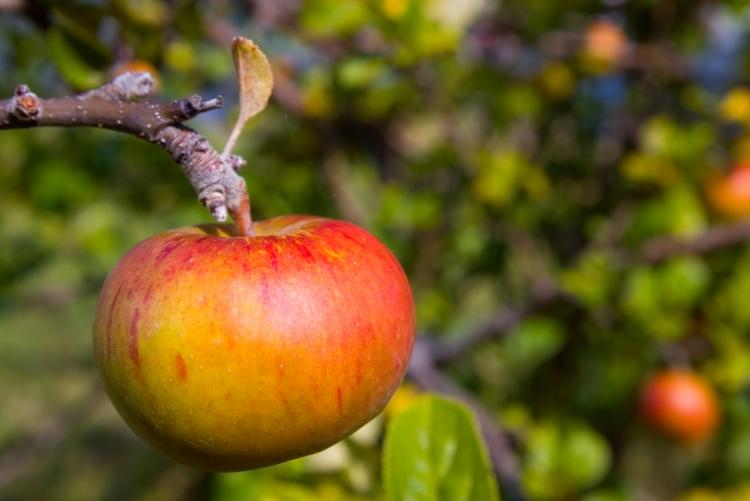
Tu B'Shevat is a Jewish observance known as the "New Year for Trees".
©iStockphoto.com/Ashley Whitworth
Tu B’Shevat, which is the start of a “New Year for Trees” in the Jewish calendar, marks a time for many Jewish people in Australia to engage in activities such as eating fruit or planting trees. The Torah praises seven “fruits”, in particular grapes, figs, pomegranates, olives and dates. Many Jewish people eat a new fruit, which can be any seasonal fruit. It is also customary for blessings to be recited as part of this ritual.
Many Jewish synagogues or organizations post reminders about Tu B’Shevat on their websites or newsletters weeks or months ahead of time. Other activities may include meetings that involve discussions or talks about the meaning of Tu B’Shevat.
Tu B’Shevat is not a public holiday in Australia. However, some Jewish organizations may offer a limited service to allow for festivities to occur on this day.
Tu B’Shevat is first referred to in the late Second Temple period (515 BCE to 20 CE) when it was the cut-off date for levying the tithe on the produce of fruit trees. When Jewish immigrants came to Mandatory Palestine during the 1930s, they planted trees where they could to start farming. It became customary to plant a tree for every newborn child – a cedar for a boy and a cypress or pine for a girl.
In the Jewish diaspora—Jewish communities outside of Israel—an extra day is usually added to religious observances, with the exception of Yom Kippur, which lasts only one day worldwide, and Rosh Hashana, which is celebrated over two days in both Israel and the diaspora.
This custom has its roots in ancient times when the beginning of the months in the Jewish calendar still relied on the sighting of the crescent Moon following a New Moon.
The beginning of a new month was determined by the Sanhedrin, the supreme court of ancient Israel in Jerusalem. Once the date was published, messengers were dispatched to spread the news among Jews living abroad. Since this process took some time, it was decreed that Jews outside of ancient Israel were to observe every holiday for 2 days to make sure that the rules and customs applicable to each holiday were observed on the proper date. This rule is still observed today.
Note: Jewish holidays begin at sundown the day before the date specified for the holiday.
| Year | Weekday | Date | Name | Holiday Type |
|---|---|---|---|---|
| 2020 | Mon | Feb 10 | Tu B'Shevat | Jewish holiday |
| 2021 | Thu | Jan 28 | Tu B'Shevat | Jewish holiday |
| 2022 | Mon | Jan 17 | Tu B'Shevat | Jewish holiday |
| 2023 | Mon | Feb 6 | Tu B'Shevat | Jewish holiday |
| 2024 | Thu | Jan 25 | Tu B'Shevat | Jewish holiday |
| 2025 | Thu | Feb 13 | Tu B'Shevat | Jewish holiday |
| 2026 | Mon | Feb 2 | Tu B'Shevat | Jewish holiday |
| 2027 | Sat | Jan 23 | Tu B'Shevat | Jewish holiday |
| 2028 | Sat | Feb 12 | Tu B'Shevat | Jewish holiday |
| 2029 | Wed | Jan 31 | Tu B'Shevat | Jewish holiday |
| 2030 | Sat | Jan 19 | Tu B'Shevat | Jewish holiday |
While we diligently research and update our holiday dates, some of the information in the table above may be preliminary. If you find an error, please let us know.
What’s up in the day and night sky in December 2025, including the Geminid meteor shower and the December solstice.
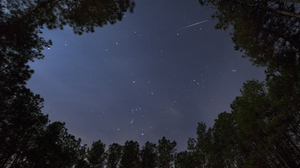
Discover when, where, and how to watch the 2025 Geminid Meteor Shower, one of the greatest meteor showers this year. Includes tips for catching the best views.

When humans return to the lunar surface in 2027, they’ll land near the South Pole. We show you how to find it while gazing at the Moon.
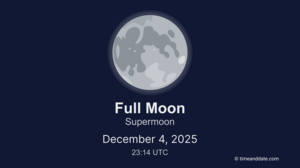
Discover the phases of the Moon in December 2025. Also, why does the Full Moon appear higher in the sky in the winter months and lower in summer?