
| Current Time: | Dec 5, 2025 at 1:51:11 am |
|---|---|
| Moon Direction: | ↑ 280° West |
| Moon Altitude: | 71.4° |
| Moon Distance: | 222,238 mi |
| Next New Moon: | Dec 19, 2025, 8:43 pm |
| Next Full Moon: | Jan 3, 2026, 5:02 am |
| Next Moonset: | Today, 7:45 am |
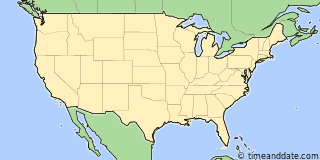

Moonrise, Moonset, and Phase Calendar for Sunrise, March 2025
| 2025 | Moonrise/Moonset | Meridian Passing | ||||||||
|---|---|---|---|---|---|---|---|---|---|---|
| Mar | Moonrise | Moonset | Moonrise | Time | Distance (mi) | Illumination | ||||
| 1 | 7:47 am | ↑ (89°) | 8:22 pm | ↑ (275°) | - | 2:01 pm | (66.4°) | 224,917 | 4.4% | |
| 2 | 8:22 am | ↑ (81°) | 9:28 pm | ↑ (283°) | - | 2:51 pm | (73.7°) | 225,323 | 10.9% | |
| 3 | 9:00 am | ↑ (73°) | 10:36 pm | ↑ (290°) | - | 3:44 pm | (80.4°) | 226,632 | 19.8% | |
| 4 | 9:41 am | ↑ (67°) | 11:44 pm | ↑ (296°) | - | 4:39 pm | (85.9°) | 228,635 | 30.3% | |
| 5 | 10:28 am | ↑ (62°) | - | - | 5:37 pm | (90.0°) | 231,099 | 41.8% | ||
 6 6 | - | 12:52 am | ↑ (300°) | 11:20 am | ↑ (59°) | 6:37 pm | (87.8°) | 233,794 | 53.4% | |
| 7 | - | 1:57 am | ↑ (302°) | 12:18 pm | ↑ (58°) | 7:38 pm | (87.5°) | 236,528 | 64.6% | |
| 8 | - | 2:55 am | ↑ (302°) | 1:20 pm | ↑ (59°) | 8:35 pm | (89.1°) | 239,171 | 74.8% | |
| Note: hours shift because clocks change forward 1 hour. (See the note below this table for details) | ||||||||||
| 9 | - | 4:47 am | ↑ (300°) | 3:22 pm | ↑ (62°) | 10:29 pm | (87.8°) | 241,646 | 83.5% | |
| 10 | - | 5:31 am | ↑ (296°) | 4:23 pm | ↑ (67°) | 11:19 pm | (83.5°) | 243,921 | 90.6% | |
| 11 | - | 6:09 am | ↑ (291°) | 5:21 pm | ↑ (72°) | Moon does not pass the meridian on this day. | ||||
| 12 | - | 6:42 am | ↑ (285°) | 6:16 pm | ↑ (78°) | 12:05 am | (78.3°) | 245,978 | 95.7% | |
| 13 | - | 7:12 am | ↑ (278°) | 7:09 pm | ↑ (85°) | 12:47 am | (72.5°) | 247,812 | 98.9% | |
 14 14 | - | 7:41 am | ↑ (272°) | 8:01 pm | ↑ (92°) | 1:28 am | (66.5°) | 249,396 | 100.0% | |
| 15 | - | 8:08 am | ↑ (265°) | 8:52 pm | ↑ (98°) | 2:07 am | (60.5°) | 250,688 | 99.1% | |
| 16 | - | 8:36 am | ↑ (259°) | 9:44 pm | ↑ (104°) | 2:47 am | (54.6°) | 251,612 | 96.4% | |
| 17 | - | 9:06 am | ↑ (253°) | 10:37 pm | ↑ (110°) | 3:28 am | (49.1°) | 252,084 | 91.9% | |
| 18 | - | 9:38 am | ↑ (248°) | 11:32 pm | ↑ (115°) | 4:10 am | (44.2°) | 252,003 | 85.9% | |
| 19 | - | 10:15 am | ↑ (243°) | - | 4:55 am | (40.0°) | 251,276 | 78.4% | ||
| 20 | 12:28 am | ↑ (119°) | 10:56 am | ↑ (240°) | - | 5:44 am | (36.8°) | 249,834 | 69.8% | |
| 21 | 1:25 am | ↑ (122°) | 11:44 am | ↑ (238°) | - | 6:35 am | (34.9°) | 247,647 | 60.3% | |
 22 22 | 2:21 am | ↑ (122°) | 12:38 pm | ↑ (238°) | - | 7:29 am | (34.4°) | 244,753 | 50.1% | |
| 23 | 3:14 am | ↑ (122°) | 1:37 pm | ↑ (239°) | - | 8:24 am | (35.5°) | 241,255 | 39.6% | |
| 24 | 4:03 am | ↑ (119°) | 2:40 pm | ↑ (243°) | - | 9:20 am | (38.3°) | 237,362 | 29.3% | |
| 25 | 4:47 am | ↑ (114°) | 3:45 pm | ↑ (248°) | - | 10:13 am | (42.6°) | 233,331 | 19.6% | |
| 26 | 5:27 am | ↑ (108°) | 4:50 pm | ↑ (255°) | - | 11:05 am | (48.3°) | 229,515 | 11.1% | |
| 27 | 6:05 am | ↑ (101°) | 5:55 pm | ↑ (263°) | - | 11:56 am | (55.1°) | 226,257 | 4.7% | |
| 28 | 6:40 am | ↑ (93°) | 7:00 pm | ↑ (271°) | - | 12:46 pm | (62.5°) | 223,899 | 0.9% | |
 29 29 | 7:16 am | ↑ (85°) | 8:07 pm | ↑ (279°) | - | 1:37 pm | (70.0°) | 222,670 | 0.1% | |
| 30 | 7:53 am | ↑ (77°) | 9:16 pm | ↑ (287°) | - | 2:30 pm | (77.3°) | 222,704 | 2.7% | |
| 31 | 8:34 am | ↑ (70°) | 10:26 pm | ↑ (294°) | - | 3:26 pm | (83.6°) | 223,953 | 8.3% | |
| * All times are local time for Sunrise. Time is adjusted for DST when applicable. They take into account refraction. Dates are based on the Gregorian calendar. Illumination is calculated at lunar noon. | ||||||||||
Total Lunar Eclipse visible in Sunrise on Mar 13 – Mar 14
Note that Daylight Saving Time starts on Sunday, March 9, 2025 at 2:00 am, and this is accounted for above.
Jan | Feb | Mar | Apr | May | Jun | Jul | Aug | Sep | Oct | Nov | Dec
Elsewhere on timeanddate.com

Skywatching Tips for December 2025
What’s up in the day and night sky in December 2025, including the Geminid meteor shower and the December solstice.
Don’t Miss the Geminid Meteor Shower 2025
Discover when, where, and how to watch the 2025 Geminid Meteor Shower, one of the greatest meteor showers this year. Includes tips for catching the best views.

Artemis III: Where on the Moon Is the South Pole?
When humans return to the lunar surface in 2027, they’ll land near the South Pole. We show you how to find it while gazing at the Moon.
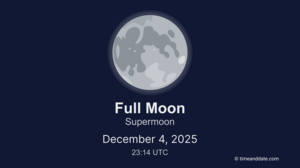
Moon Guide for December 2025
Discover the phases of the Moon in December 2025. Also, why does the Full Moon appear higher in the sky in the winter months and lower in summer?