| Current Time: | Jul 27, 2024 at 3:16:52 am |
|---|---|
| Moon Direction: | ↑ 95° East |
| Moon Altitude: | 34.4° |
| Moon Distance: | 229,350 mi |
| Next New Moon: | Aug 4, 2024, 12:13 pm |
| Next Full Moon: | Aug 19, 2024, 7:25 pm |
| Next Moonset: | Today, 1:40 pm |
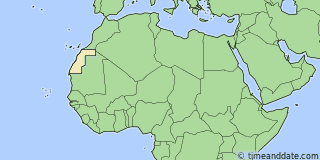

Moonrise, Moonset, and Phase Calendar for Dakhla, July 2024
Scroll right to see more
| 2024 | Moonrise/Moonset | Meridian Passing | ||||||||
|---|---|---|---|---|---|---|---|---|---|---|
| Jul | Moonrise | Moonset | Moonrise | Time | Distance (mi) | Illumination | ||||
| 1 | 3:16 am | ↑ (72°) | 4:49 pm | ↑ (291°) | - | 9:59 am | (84.2°) | 231,945 | 23.5% | |
| 2 | 3:58 am | ↑ (66°) | 5:53 pm | ↑ (296°) | - | 10:53 am | (89.2°) | 233,370 | 14.4% | |
| 3 | 4:46 am | ↑ (62°) | 6:58 pm | ↑ (300°) | - | 11:50 am | (87.3°) | 235,118 | 7.4% | |
| 4 | 5:39 am | ↑ (59°) | 8:00 pm | ↑ (301°) | - | 12:48 pm | (85.5°) | 237,176 | 2.6% | |
 5 5 | 6:36 am | ↑ (59°) | 8:57 pm | ↑ (301°) | - | 1:47 pm | (85.5°) | 239,490 | 0.4% | |
| 6 | 7:36 am | ↑ (60°) | 9:47 pm | ↑ (298°) | - | 2:43 pm | (87.2°) | 241,962 | 0.6% | |
| 7 | 8:37 am | ↑ (63°) | 10:30 pm | ↑ (294°) | - | 3:36 pm | (89.6°) | 244,450 | 3.1% | |
| 8 | 9:34 am | ↑ (68°) | 11:08 pm | ↑ (289°) | - | 4:24 pm | (85.2°) | 246,785 | 7.6% | |
| 9 | 10:30 am | ↑ (73°) | 11:42 pm | ↑ (284°) | - | 5:08 pm | (80.2°) | 248,785 | 13.7% | |
| 10 | 11:22 am | ↑ (79°) | - | - | 5:50 pm | (74.6°) | 250,279 | 21.2% | ||
| 11 | - | 12:12 am | ↑ (278°) | 12:12 pm | ↑ (85°) | 6:29 pm | (68.8°) | 251,117 | 29.7% | |
| 12 | - | 12:41 am | ↑ (271°) | 1:01 pm | ↑ (92°) | 7:08 pm | (62.9°) | 251,192 | 38.9% | |
 13 13 | - | 1:09 am | ↑ (265°) | 1:51 pm | ↑ (98°) | 7:47 pm | (57.2°) | 250,448 | 48.5% | |
| 14 | - | 1:39 am | ↑ (259°) | 2:42 pm | ↑ (104°) | 8:28 pm | (51.7°) | 248,887 | 58.3% | |
| 15 | - | 2:10 am | ↑ (253°) | 3:35 pm | ↑ (110°) | 9:12 pm | (46.6°) | 246,583 | 68.0% | |
| 16 | - | 2:45 am | ↑ (248°) | 4:32 pm | ↑ (115°) | 10:00 pm | (42.3°) | 243,674 | 77.2% | |
| 17 | - | 3:26 am | ↑ (243°) | 5:31 pm | ↑ (119°) | 10:53 pm | (39.1°) | 240,367 | 85.4% | |
| 18 | - | 4:13 am | ↑ (240°) | 6:33 pm | ↑ (121°) | 11:50 pm | (37.4°) | 236,921 | 92.3% | |
| 19 | - | 5:07 am | ↑ (239°) | 7:33 pm | ↑ (121°) | Moon does not pass the meridian on this day. | ||||
| 20 | - | 6:09 am | ↑ (239°) | 8:30 pm | ↑ (120°) | 12:51 am | (37.4°) | 233,628 | 97.2% | |
 21 21 | - | 7:15 am | ↑ (242°) | 9:22 pm | ↑ (116°) | 1:51 am | (39.4°) | 230,774 | 99.6% | |
| 22 | - | 8:23 am | ↑ (247°) | 10:08 pm | ↑ (110°) | 2:51 am | (43.2°) | 228,595 | 99.3% | |
| 23 | - | 9:30 am | ↑ (253°) | 10:49 pm | ↑ (103°) | 3:46 am | (48.6°) | 227,240 | 96.0% | |
| 24 | - | 10:34 am | ↑ (260°) | 11:27 pm | ↑ (96°) | 4:39 am | (55.1°) | 226,752 | 90.0% | |
| 25 | - | 11:37 am | ↑ (268°) | - | 5:29 am | (62.1°) | 227,075 | 81.5% | ||
| 26 | 12:03 am | ↑ (88°) | 12:38 pm | ↑ (276°) | - | 6:17 am | (69.4°) | 228,084 | 71.3% | |
| 27 | 12:39 am | ↑ (81°) | 1:40 pm | ↑ (283°) | - | 7:06 am | (76.4°) | 229,614 | 59.9% | |
 28 28 | 1:17 am | ↑ (74°) | 2:43 pm | ↑ (290°) | - | 7:56 am | (82.7°) | 231,501 | 48.2% | |
| 29 | 1:57 am | ↑ (68°) | 3:46 pm | ↑ (295°) | - | 8:49 am | (88.0°) | 233,603 | 36.7% | |
| 30 | 2:42 am | ↑ (63°) | 4:50 pm | ↑ (299°) | - | 9:44 am | (88.1°) | 235,817 | 26.2% | |
| 31 | 3:33 am | ↑ (60°) | 5:52 pm | ↑ (301°) | - | 10:41 am | (85.7°) | 238,074 | 17.0% | |
| * All times are local time for Dakhla. Time is adjusted for DST when applicable. They take into account refraction. Dates are based on the Gregorian calendar. Illumination is calculated at lunar noon. | ||||||||||
Jan | Feb | Mar | Apr | May | Jun | Jul | Aug | Sep | Oct | Nov | Dec