
Skywatching Tips for December 2025
What’s up in the day and night sky in December 2025, including the Geminid meteor shower and the December solstice.

New Year’s Day, celebrated on January 1, marks the beginning of the year in the Gregorian calendar. It follows the festivities of New Year’s Eve and offers a moment for reflection and new beginnings.

New Year’s Eve celebrations conclude with fireworks welcoming the first moments of New Year’s Day.
©iStock.com/Alexandre Rocha
New Year’s Day (January 1) is both a federal and a state public holiday in the United States. Federal government offices, post offices, banks, and most state and local government offices are closed. Many schools and businesses also close or operate with reduced hours to mark the occasion.
New Year’s Day is observed every year on January 1, the first day of the year in the Gregorian calendar. If January 1 falls on a weekend, the federal government may observe the holiday on the closest weekday.
While the most iconic New Year celebration happens on New Year’s Eve (the last day of the year), January 1 is often a time for relaxation and recovery. Traditional celebrations include:
Some US cities host unique New Year’s Day events. For example:
The celebration of New Year’s dates back to ancient civilizations, such as the Babylonians, who marked the beginning of the year with spring festivals. In 46 BCE, Julius Caesar introduced the Julian calendar, establishing January 1 as the start of the year in honor of Janus, the Roman god of beginnings.
In 1582, Pope Gregory XIII reformed the calendar to correct inaccuracies, creating today’s Gregorian calendar. The British Empire, along with its North American colonies, which are now known as Canada and the United States, adopted it in 1752, aligning its New Year’s traditions with those of many Western nations.
| Year | Weekday | Date | Name | Holiday Type | Area |
|---|---|---|---|---|---|
| 2020 | Wed | Jan 1 | New Year's Day | Federal Holiday | |
| 2021 | Fri | Jan 1 | New Year's Day | State Holiday | All |
| 2021 | Fri | Jan 1 | New Year's Day | Federal Holiday | |
| 2021 | Fri | Dec 31 | New Year's Day (substitute) | Federal Holiday | |
| 2021 | Fri | Dec 31 | New Year's Day (substitute) | State Holiday | All except GA, MA, MS, NY, RI, TX, WI |
| 2022 | Sat | Jan 1 | New Year's Day | Federal Holiday | |
| 2022 | Sat | Jan 1 | New Year's Day | State Holiday | All except MA, MS, NY, TX, WI |
| 2022 | Sat | Jan 1 | New Year's Day | State Holiday | MA, MS, NY, TX, WI |
| 2022 | Mon | Jan 3 | New Year's Day (substitute) | State Holiday | Georgia, Rhode Island |
| 2023 | Sun | Jan 1 | New Year's Day | Federal Holiday | |
| 2023 | Sun | Jan 1 | New Year's Day | State Holiday | All except TX |
| 2023 | Sun | Jan 1 | New Year's Day | State Holiday | Texas |
| 2023 | Mon | Jan 2 | New Year's Day (substitute) | State Holiday | All except TX |
| 2023 | Mon | Jan 2 | New Year's Day (substitute) | Federal Holiday | |
| 2024 | Mon | Jan 1 | New Year's Day | Federal Holiday | |
| 2024 | Mon | Jan 1 | New Year's Day | State Holiday | All |
| 2025 | Wed | Jan 1 | New Year's Day | State Holiday | All |
| 2025 | Wed | Jan 1 | New Year's Day | Federal Holiday | |
| 2026 | Thu | Jan 1 | New Year's Day | State Holiday | All |
| 2026 | Thu | Jan 1 | New Year's Day | Federal Holiday | |
| 2027 | Fri | Jan 1 | New Year's Day | Federal Holiday | |
| 2027 | Fri | Jan 1 | New Year's Day | State Holiday | All |
| 2027 | Fri | Dec 31 | New Year's Day (substitute) | Federal Holiday | |
| 2027 | Fri | Dec 31 | New Year's Day (substitute) | State Holiday | All except MA, MS, NY, RI, TX, WI |
| 2028 | Sat | Jan 1 | New Year's Day | State Holiday | All except MA, MS, NY, TX, WI |
| 2028 | Sat | Jan 1 | New Year's Day | State Holiday | MA, MS, NY, TX, WI |
| 2028 | Sat | Jan 1 | New Year's Day | Federal Holiday | |
| 2028 | Mon | Jan 3 | New Year's Day (substitute) | State Holiday | Rhode Island |
| 2029 | Mon | Jan 1 | New Year's Day | Federal Holiday | |
| 2029 | Mon | Jan 1 | New Year's Day | State Holiday | All |
| 2030 | Tue | Jan 1 | New Year's Day | Federal Holiday | |
| 2030 | Tue | Jan 1 | New Year's Day | State Holiday | All |
While we diligently research and update our holiday dates, some of the information in the table above may be preliminary. If you find an error, please let us know.
What’s up in the day and night sky in December 2025, including the Geminid meteor shower and the December solstice.
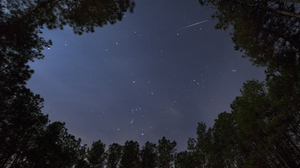
Discover when, where, and how to watch the 2025 Geminid Meteor Shower, one of the greatest meteor showers this year. Includes tips for catching the best views.

When humans return to the lunar surface in 2027, they’ll land near the South Pole. We show you how to find it while gazing at the Moon.
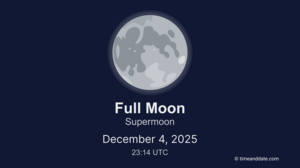
Discover the phases of the Moon in December 2025. Also, why does the Full Moon appear higher in the sky in the winter months and lower in summer?