
Up All Night, and Bright
Saturn is at its brightest and best in 2025 around September 21. This is when the planet reaches opposition—which means it lies directly opposite the Sun in our sky.
For skywatchers, this means Saturn is up all night: It rises around sunset, reaches its highest point around midnight, and sets around sunrise. Plus, Saturn is at its closest to Earth around opposition: This means it shines more brightly in our sky than at other times of the year.
This isn’t a one-night-only performance: Saturn will be shining brightly in the days and weeks around September 21. To the naked eye, the planet looks like a bright star; to see Saturn’s famous rings, you’ll need a telescope.
Show Saturn on our Night Sky Map for your cityCoincidentally, this year Saturn is at opposition around the time of Earth’s equinox, when nighttime lasts 12 hours or so in every town and city in the world.
When is the September equinox?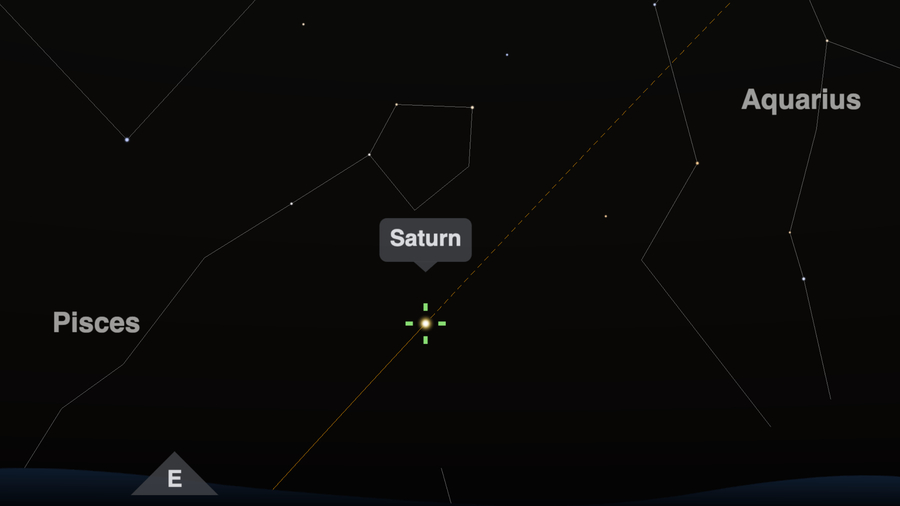
When the Rings Look Thin
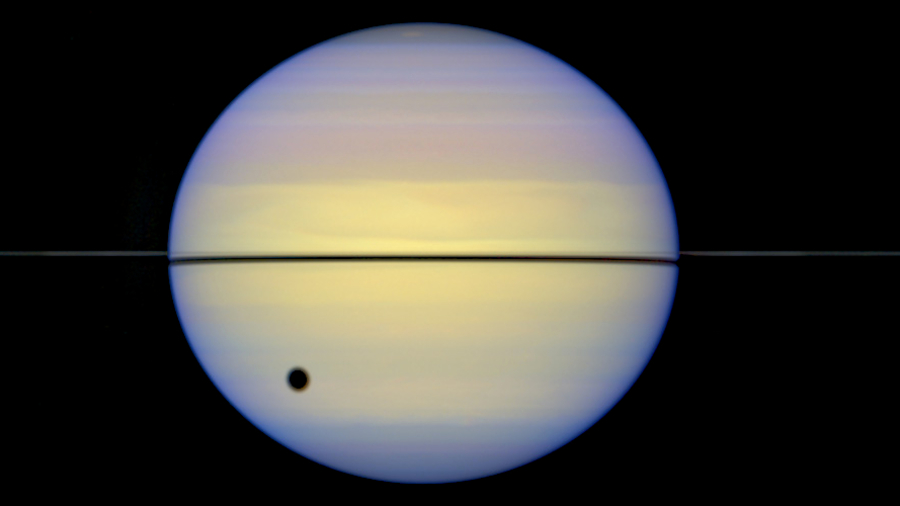
This year’s opposition is also close to Saturn’s equinox. As on Earth, equinox on Saturn is when the Sun lies directly above the planet’s equator—neither the northern hemisphere nor the southern hemisphere is tilted toward the Sun.
In the case of Saturn, this means the planet’s rings appear to us edge-on. In other words, when we look at the planet through a telescope, the rings look more like a thin line, as opposed to a thick band.
Whereas Earth completes one orbit every 12 months, Saturn takes about 30 years to go once round the Sun. As a result, equinox on Saturn only happens once every 15 years or so, compared to once every 6 months on Earth.
The most recent equinox on Saturn was just a few months ago, in May 2025. Consequently, Saturn’s rings still look quite thin when seen through a telescope—as we showed in the top-right corner of our lunar eclipse live stream earlier this month.
Saturn: The ringed planetIn Summary: Look Up!
This is a great time to catch Saturn, at more or less any time of the night. You’ll need a telescope to see the planet’s rings, which look relatively thin in 2025.