| Night Time: | 1 hour, 25 minutes |
|---|---|
| Sunset: | Dec 6 at 11:46 pm |
| End of Twilight*: | None |
| Start of Twilight*: | None |
| Sunrise: | Dec 7 at 1:11 am |


Coming Up in December
Nights are at their darkest in the Northern Hemisphere, and the Full Moon rides high in the sky. Meanwhile, the Southern Hemisphere enjoys long, bright evenings.
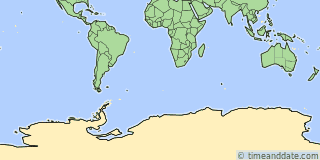
Our Interactive Night Sky Map simulates the sky above 66°13'42.9"S, 110°36'01.4"E. The Moon and planets have been enlarged slightly for clarity. On mobile devices, tap to steer the map by pointing your device at the sky. Need some help?

Currently showing previous night. For planet visibility in the coming night, please check again after 12 noon.
Tonight's Sky in 66°13'42.9"S, 110°36'01.4"E, Dec 6 – Dec 7, 2025

Mercury rise and set in 66°13'42.9"S, 110°36'01.4"E
Try at night.
Can only be seen shortly, if at all, it is very close to the horizon.
Time:
Altitude: °
Direction: °

Venus rise and set in 66°13'42.9"S, 110°36'01.4"E
Fairly close to the Sun. Visible only after sunset.
Venus is just 8 degrees from the Sun in the sky, so it is difficult to see. Venus is visible by day, but may be hard to find.
Time:
Altitude: °
Direction: °

Mars rise and set in 66°13'42.9"S, 110°36'01.4"E
Very close to Sun, hard or impossible to see.
Mars is just 9 degrees from the Sun in the sky, so it is difficult or impossible to see it.
Time:
Altitude: °
Direction: °

Jupiter rise and set in 66°13'42.9"S, 110°36'01.4"E
After sunset and most of the night.
Jupiter is visible during most of the night, but it is best viewed in the late evening hours after sunset.
Time:
Altitude: °
Direction: °

Saturn rise and set in 66°13'42.9"S, 110°36'01.4"E
Hard to see.
Saturn rises above the horizon for a short period only and remains very low in the sky, so it is unlikely to be visible.
Time:
Altitude: °
Direction: °

Uranus rise and set in 66°13'42.9"S, 110°36'01.4"E
Up most of the night. Bring binoculars.
Uranus is roughly in the opposite direction of the Sun, so it is visible during most of the night. It is very close to the horizon, making it fainter because the light has to cover a larger distance when traveling through the Earth's atmosphere. Make sure to get an unobstructed view with as little light pollution as possible. You may need binoculars.
Time:
Altitude: °
Direction: °

Neptune rise and set in 66°13'42.9"S, 110°36'01.4"E
Hard to see. Use binoculars.
Neptune rises above the horizon for a short period only and remains very low in the sky, so it is unlikely to be visible. Very faint, use binoculars.
Time:
Altitude: °
Direction: °
Planets Visible in 66°13'42.9"S, 110°36'01.4"E
| Planetrise/Planetset, Sun, Dec 7, 2025 | ||||
|---|---|---|---|---|
| Planet | Rise | Set | Meridian | Comment |
| Mercury | Sun 2:07 am | Sun 8:06 pm | Sun 11:06 am | Slightly difficult to see |
| Venus | Sun 1:40 am | Sun 10:20 pm | Sun 11:57 am | Slightly difficult to see |
| Mars | Up all day | Sat 1:06 pm | Extremely difficult to see | |
| Jupiter | Sun 1:18 am | Sun 5:18 am | Sun 3:18 am | Perfect visibility |
| Saturn | Sat 12:40 pm | Sun 2:03 am | Sat 7:21 pm | Extremely difficult to see |
| Uranus | Sat 8:49 pm | Sun 1:53 am | Sat 11:21 pm | Difficult to see |
| Neptune | Sat 1:17 pm | Sun 1:53 am | Sat 7:35 pm | Extremely difficult to see |