12 hours, 41 minutes
Fri, May 10 at 6:04 pm – Sat, May 11 at 6:45 am
Visible night of May 10 – May 11, 2024
| Mercury: | From Sat 4:53 am |
|---|---|
| Venus: | From Sat 6:17 am |
| Mars: | From Sat 3:42 am |
| Jupiter: | Until Fri 6:26 pm |
| Saturn: | From Sat 2:16 am |
| Uranus: | Until Fri 6:12 pm |
| Neptune: | From Sat 3:05 am |


After a Recent Acceleration, Earth’s Spin May Be Slowing Again
In 2023, for the first time in seven years, the average ‘length of day’ became longer. Latest predictions suggest this slowdown may continue into 2025. Read the full story.
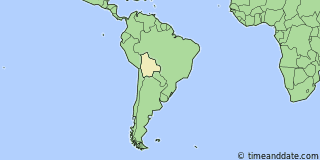
Our Interactive Night Sky Map simulates the sky above Oruro. The Moon and planets have been enlarged slightly for clarity. On mobile devices, tap to steer the map by pointing your device at the sky. Need some help?
Tonight's Sky in Oruro, May 10 – May 11, 2024 (7 planets visible)

Mercury rise and set in Oruro
View just before sunrise.
Mercury is close to the Sun and can only be seen shortly before sunrise. Try finding a good, unobstructed view of the horizon.
Sat, May 11 ↑4:53 am
Time:
Altitude: °
Direction: °

Venus rise and set in Oruro
Fairly close to the Sun. Visible only before sunrise and/or after sunset.
Venus is just 7 degrees from the Sun in the sky, so it is difficult to see. Venus is visible by day, but may be hard to find.
Sat, May 11 ↑6:17 am
Time:
Altitude: °
Direction: °

Mars rise and set in Oruro
View before sunrise.
Mars can best be seen in the hours just before sunrise. Visibility deteriorates as the sky gets brighter.
Sat, May 11 ↑3:42 am
Time:
Altitude: °
Direction: °

Jupiter rise and set in Oruro
Fairly close to the Sun. Visible only after sunset.
Jupiter is just 6 degrees from the Sun in the sky, so it is difficult to see.
Fri, May 10 ↓6:26 pm
Time:
Altitude: °
Direction: °

Saturn rise and set in Oruro
View before sunrise.
Saturn can best be seen in the hours just before sunrise. Visibility deteriorates as the sky gets brighter.
Sat, May 11 ↑2:16 am
Time:
Altitude: °
Direction: °

Uranus rise and set in Oruro
Very close to Sun, hard or impossible to see.
Uranus is just 2 degrees from the Sun in the sky, so it is difficult or impossible to see it.
Fri, May 10 ↓6:12 pm
Time:
Altitude: °
Direction: °

Neptune rise and set in Oruro
View before sunrise. Use binoculars.
Neptune can best be seen in the hours just before sunrise. Visibility deteriorates as the sky gets brighter. Very faint, use binoculars.
Sat, May 11 ↑3:05 am
Time:
Altitude: °
Direction: °
Planets Visible in Oruro
| Planetrise/Planetset, Sat, May 11, 2024 | ||||
|---|---|---|---|---|
| Planet | Rise | Set | Meridian | Comment |
| Mercury | Sat 4:53 am | Sat 4:40 pm | Sat 10:47 am | Slightly difficult to see |
| Venus | Sat 6:17 am | Sat 5:42 pm | Sat 12:00 noon | Slightly difficult to see |
| Mars | Sat 3:42 am | Sat 3:41 pm | Sat 9:41 am | Average visibility |
| Jupiter | Fri 7:12 am | Fri 6:26 pm | Fri 12:49 pm | Difficult to see |
| Saturn | Sat 2:16 am | Sat 2:36 pm | Sat 8:26 am | Average visibility |
| Uranus | Fri 6:57 am | Fri 6:12 pm | Fri 12:35 pm | Extremely difficult to see |
| Neptune | Sat 3:05 am | Sat 3:11 pm | Sat 9:08 am | Very difficult to see |