

It Could Have Been Simple
Time zones were originally designed to be straightforward. The idea was for them to slice the Earth into neat, one-hour differences.
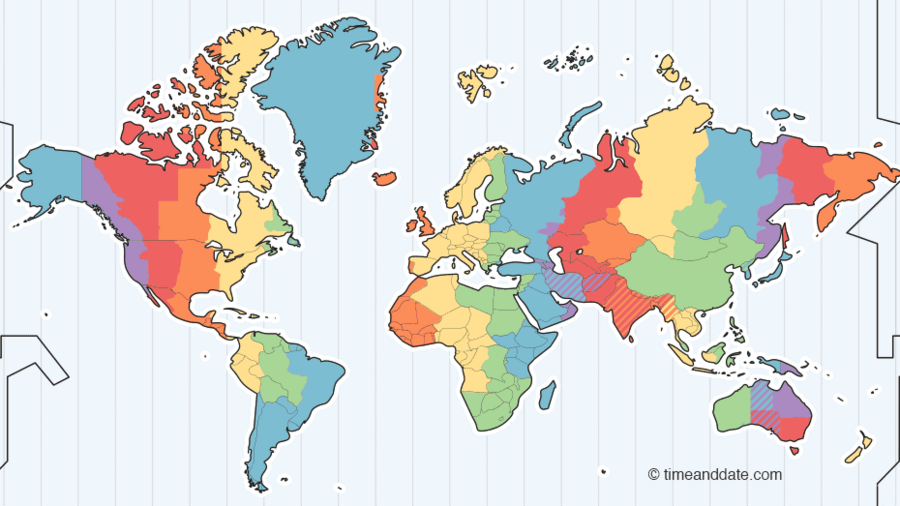
But things have become complicated. Nations have the power to draw their own zones and make their own rules, so our time landscape has evolved into something much more difficult to keep track of. Today’s time zones have been carved out to reflect national economic, political, and cultural interests—not to keep the math simple.
But that’s not the only issue. Read on to learn why converting time zones in your head can be harder than you may think.
Don’t like figuring it out yourself? Our Time Zone Converter calculates time changes around the world; the Meeting Planner provides you with the best meeting times across time zones; and our Time Zone Map shows global time zones as they currently are, accounting for all clock changes in real time.
Time Zone Conversion Basics
Let’s start simple: Off the top of your head, do you know if you need to add or subtract hours if you live in, say, New York and want to convert your time to the local time in Paris, France? (The correct answer is: add.)
Next question: How many hours do you need to add? Well, this is where the real difficulties start. The answer is: It depends.
Daylight Saving Time Muddies the Waters
The problem is that some countries move their clocks forward in spring and back in the fall for Daylight Saving Time, or DST. Since North America and Europe use different dates to trigger the switch, the time difference between New York and Paris varies throughout the year. The offset is 6 hours most of the time—but only 5 hours during some weeks in spring and fall.
Time Zones That Misbehave
What’s more, time zones don’t even always behave as expected. For example, some countries have a habit of changing their local time or Daylight Saving Time (DST) routine at short notice, and official information about these decisions can be hard to come by.
There are also places where time on the ground doesn’t even match the official time zone at all:
“I once researched Nagorno-Karabakh in the South Caucasus. We had reason to believe that the territory operated on Armenian time in practice—but officially, it was tied to Azerbaijan’s time zone. I had to call a hotel reception to ask what the time actually was.”
Konstantin Bikos, Lead Editor

Time Zone Oddities
To top it all off, some regions don’t follow the usual pattern of being offset from Coordinated Universal Time (UTC) by full-hour increments.
With a UTC offset of 5 hours and 30 minutes, India is among the countries that host unusual time zones. In an attempt to match mean solar time as closely as possible, India’s neighbor Nepal has also created a unique time zone titled Nepal Time, setting the country just 15 minutes apart from India and 5 hours and 45 minutes ahead of UTC.
Australia also uses half-hour and quarter-hour offsets in some of its time zones, and clocks change for DST only in parts of the country. The Australian territory of Lord Howe Island does observe DST—but instead of the usual one-hour difference, it turns ahead its clocks by only 30 minutes during DST.
And these are just three examples of many.
What a Difference a Day Makes
The International Date Line can further complicate matters: If your conversion crosses this boundary, you must adjust the date by adding or subtracting a day, depending on which direction you cross.
It’s also worth noting that some Pacific island nations have a history of switching allegiance from one side to the other, changing entire dates in the process.
When your clock doesn’t reflect solar time
So Much to Consider
So, if you try to do the time zone conversion math mentally, there are a lot of obstacles to clear. To make it all add up, you have to:
- Anchor the current local time.
- Decide if you need to add or subtract hours.
- Recall the standard offset of the other location.
- Know if both locations observe DST during parts of the year, and if so, when the clocks change, and by how much.
- Make sure there haven’t been any recent time zone changes in either of the locations, and that people actually live by the official time.
- Factor in the possibility that the result crosses a day boundary (yesterday/today/tomorrow).
- Apply the difference correctly.
Needless to say, that’s a complex series of equations to work out, with a lot of room for error. That’s why we at timeanddate.com spend our days trying to stay on top of all of it and keep our time zone tools and databases up-to-date—so you don’t have to.